
Behind every automotive innovation lies a human story. Hosted by Stéphane Lagresle, founder of The Storytelling Tribe, this podcast reveals how industry leaders translate complex technologies into compelling narratives. Through conversations with automotive executives, discover practical frameworks for making automotive innovations relatable and meaningful. For executives, product leaders, and marketers transforming mobility through better communication.

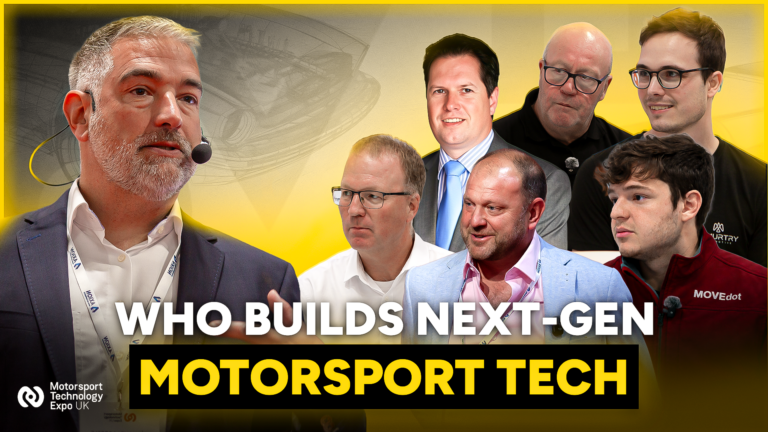
Racing technology still makes teams faster, but more of the time is now found in engineering hours than in hardware. In this episode of Automotive Storytelling, Stéphane Lagresle takes you onto the floor of the first Motorsport Technology Expo at Farnborough International with two questions. Does technology really get racing teams to the finish line faster? And what bridges actually exist between motorsport and passenger and commercial vehicles? Six conversations, recorded over two days in September, gave answers that do not line up neatly. That disagreement is the episode.
Thomas Rose shows that physics still pays: a fan system that delivers downforce at any speed gives McMurtry grip exactly where wings cannot. The other conversations point somewhere else. Lucas Vieira describes teams spending whole days building reports about races that already happened, and Jan Prins explains that a tire must still be built, rig-tested and measured before any model can predict it. For most teams, the limit is how fast engineers can turn data into a decision.
Ian Palmer argues that race cars became software defined vehicles before passenger cars did, and for economic reasons. Production runs are tiny, so hardware is reused and differentiation moves into software, configured from a single toolchain. He is just as clear that the model is getting harder to export. Motorsport stays distributed while automotive consolidates into domain controllers and Android-based cockpits, a more cautious read than Alan O’Neill’s view of racing as a straight accelerator for road technology.
The transfers that surfaced at Farnborough rarely follow the usual racing-to-road script. Thomas Rose describes McMurtry exploring deployable downforce under a loaded truck, triggered by brake pressure, to shorten emergency stops and prevent rollovers. Jan Prins points to accelerometers inside the tire tread that can derive load, road friction and wear from the only part of the vehicle touching the road. Lucas Vieira’s pre-built analyses, run the moment a test car unloads its data, fit any validation program.
Alan O’Neill lectured motorsport engineering, concluded that the qualifications were not producing what teams need, and founded SCU Motorsport to change that with a new qualification, a single seater that colleges buy and prepare, and a race series. His argument sits under every other conversation in the episode. Universities train people to design electrical systems, but if nobody on the shop floor can work on them, those systems become useless very quickly.
Thomas Rose, Commercial Engineering Manager, McMurtry Automotive. Downforce on demand, and what it could do for a loaded truck. Phil White, Managing Director, Axion Shows and Conferences. Why the UK needed this show. Ian Palmer, Commercial Director, Cosworth Electronics. Why race cars became software defined vehicles first. Lucas Vieira, Forward Deployed Engineer, MOVEdot. AI agents that hand race engineers their time back. Jan Prins, Founder, JP76 Solutions, after 35 years at Jaguar Land Rover. Why the tire is still the hardest component to predict. Alan O'Neill, Founder, SCU Motorsport. The skills gap under every technology bridge.
Under the Hood: Automotive Storytelling uncovers the human narratives driving innovation in an industry that impacts lives worldwide. Hosted by Stéphane Lagresle, this podcast explores how the power of storytelling ultimately connects technology to humans.