
The short answer
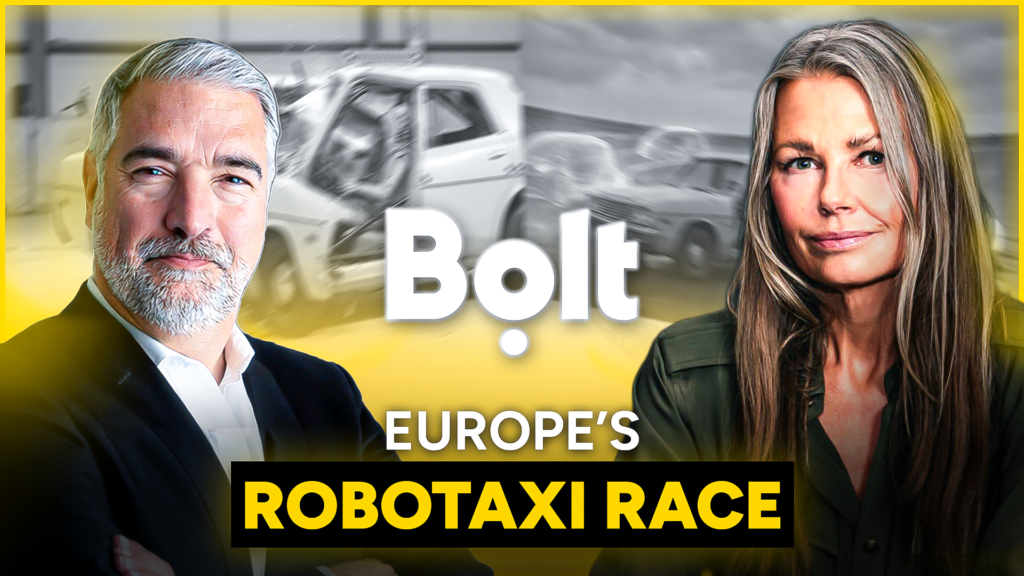
Bolt’s robotaxi strategy in Europe is targeting 100,000 commercial vehicles by 2035, backed by partnerships with Pony.ai and Stellantis. Charlotte Eisner, Head of Strategic Partnerships, explains why building slower — and safer — is exactly how Europe wins the autonomous mobility race.
Key takeaways:
- Bolt is not competing with human drivers — it is competing with privately owned cars, which sit idle 95–98% of the time.
- Europe’s triple-layer safety model (operational + process + product) takes longer but produces a defensible, insurable product that scales without class-action exposure.
- The “lucky clover” strategy positions Bolt across four revenue leaves: private ride hailing, public transport integration, B2G municipal services, and B2B enterprise contracts.
- Charlotte Eisner’s appointment as Strategic Advisor to the NATO Science and Technology Organization is not a side project — it directly shapes the vehicle’s technical requirements for civil defense and resilience use cases.
- Purpose-built Level 4 vehicles, not retrofitted consumer cars, are the only credible path to scale in Europe’s regulatory environment.
What is Bolt’s robotaxi plan for Europe?
Bolt wants 100,000 commercial robotaxis operational across Europe by 2035. That number is not a press release aspiration. It is attached to a specific hardware strategy, two confirmed Tier-1 partnerships, and a regulatory playbook that Charlotte Eisner, Bolt’s Head of Strategic Partnerships, has spent the better part of a decade developing across three successive autonomous vehicle ventures.
The hardware anchor is the partnership with Stellantis. The software comes from Pony.ai, a Chinese-American ADS (Autonomous Drive System) developer with more than 33 million autonomous miles logged and commercial robotaxi operations already running in China. Bolt is not building the car, and it is not building the ADS stack. It is building the mobility platform — the demand generation engine — that already carries millions of riders and rides across 45+ countries.
“We already have millions and millions of users and rides in our network today,” Eisner told Under the Hood. “We have the ability to combine micro mobility solutions with goods delivery and now the defence vertical. We’re very good at launching new products on our network.”
That platform advantage matters more than it looks. Waymo needed years to build rider trust from zero. Bolt starts with an installed base.
Why does Europe approve robotaxis differently from the US?
In the United States, the dominant model is self-certification: an ADS supplier claims their system is safe, launches in a permissive territory, logs autonomous kilometers, and expands until regulators intervene. Waymo has executed this playbook near-perfectly. The approach produces fast data accumulation and fast commercial deployment — but it also produced the Cruise incident in San Francisco and the earlier Uber fatality in Tempe, Arizona, both of which triggered retroactive investigations into product safety and process integrity that the companies had not documented in advance.
Europe is running a different sequence. “In Europe we want operational safety, process safety, and product safety all documented before we let the cars on the street,” Eisner explains. “We’re looking at all three. I think this is something that Europe should continue to be proud of.”
The practical consequence is a slower go-to-market, but a structurally cleaner one. A vehicle type-approved under European rules can be insured with defined liability. In the US, class-action exposure if something goes wrong is existential. In Europe, if the documentation is right and the product clears homologation, the liability framework is workable.
Eisner is direct about what this means for teams used to Silicon Valley speed: “You cannot risk any accident. You cannot move fast.” But she is equally direct that the gap with the US is closing, and that no one — including Waymo, including the Chinese players — has demonstrated scaled commercial deployment in a European regulatory environment. Nobody has that yet.
Will Bolt’s robotaxis replace human drivers?
Bolt’s stated target is not the taxi market. It is the privately owned car. The average privately owned car in Europe is used between 2 and 5% of the time. The owner pays for insurance, financing, parking, maintenance, and tolls on 100% of its existence. Robotaxis, in Bolt’s framing, are competing with that math — not with the income of professional drivers.
“We would rather want the family to own maximum one car, preferably no car,” Eisner says. “But taxi services will still be needed, because there are always riders who need a physical person to assist them.”
The jobs argument that typically surfaces here — autonomous vehicles will eliminate driving jobs — gets a more nuanced answer than most. Eisner draws a historical comparison: telephone operators and elevator attendants also disappeared, and the people who held those roles found other work. More concretely, a scaled robotaxi fleet generates new employment: safety drivers in the early phases, safety officers, depot technicians doing sensor calibration, interior and exterior cleaning, and maintenance. These are not equivalent jobs, but they exist.
There is also a driver shortage problem that most people outside the industry underestimate. Across Europe, fewer people are training for commercial driving roles, and the current cohort is aging out. “A lot of drivers are retiring, less and less want to work with this,” Eisner notes. “This will be a natural development.”
What is Bolt’s “lucky clover” model?
Bolt is not building a single-use robotaxi product. It is structuring its deployment around four distinct revenue streams that Eisner calls the lucky clover — a frame she uses consistently when talking to cities, OEMs, investors, and regulators.
Leaf one: Private ride hailing. The obvious use case. A rider books a robotaxi through the Bolt app. This is the Waymo model, except with Bolt’s existing network underneath it.
Leaf two: Public transport integration. Robotaxis filling the gaps that buses and trains cannot serve economically — late-night routes, low-demand corridors, last-mile connections from transit stops. This is where Bolt’s “build cities for people, not for cars” founding narrative connects directly to AV deployment.
Leaf three: B2G (Business to Government). Municipal contracts for non-emergency medical transport — hospital runs, elderly mobility, care for disabled passengers who currently cannot travel affordably because the cost of human-driven private transport is too high and public transit doesn’t reach their door. “I am passionate about this,” Eisner says. “Today they cannot travel because it’s too expensive or there aren’t enough drivers.”
Leaf four: B2B enterprise contracts. Property developers offering autonomous mobility as an amenity — replacing parking garages with gardens and robotaxi subscriptions. Airlines providing business-class airport transfers. Corporate campuses managing employee mobility at scale.
The clover framing serves a communication purpose beyond strategy. When Bolt walks into a city negotiation, the pitch is not “let us put robots in your streets.” It is: here are four specific problems your city has, and here is how one service solves all of them simultaneously.
What does NATO have to do with Bolt’s autonomous strategy?
Eisner’s recent appointment as Strategic Advisor on Automated Transportation to the NATO Science and Technology Organization surprised many people who associate the organization exclusively with military hardware. The actual scope is civil defense and resilience.
“This is not about creating autonomous bomb drones,” Eisner is explicit. “This is logistics, people transport, and goods transportation under crisis — to make sure that we have a way of getting people and goods in and out of different places.”
The defense vertical has a direct technical implication for Bolt’s vehicle requirements. Civil defense use cases — border zone logistics in Norway, Sweden, and Finland, for example, where long borders meet sparse populations — extend well beyond the geofenced urban areas where Level 4 systems currently perform most reliably. These are environments with heavy snow, peripheral roads, and no fallback infrastructure. Designing for this edge case tightens the vehicle specification for every other use case.
There is also a sovereignty dimension. European autonomous mobility platforms cannot depend on foreign-controlled sensor hardware, connectivity infrastructure, or ADS software in contexts where that supply chain could be interrupted or compromised. “We cannot be dependent on any foreign — even Chinese, or I would say today, not even US technology,” Eisner says, noting that the current geopolitical climate has sharpened this conversation at the NATO level. This creates a structural opportunity for European ADS and hardware suppliers — and a screening criterion for who Bolt can realistically partner with.
How do you convince OEMs, cities, and the public to adopt robotaxis at the same time?
This is the part of the autonomous mobility problem that gets less attention than sensor specifications and regulatory timelines, but it is arguably the harder one. Bolt needs OEMs to manufacture vehicles they will sell in lower volumes. It needs cities to reallocate road space and update permits. It needs riders who have never trusted a driverless car to try one.
Eisner’s approach is to keep the story identical across all three audiences, but to make the entry point for each audience specific to their pain.
With automotive manufacturers, the tension is direct: Bolt is asking companies to produce a vehicle optimized for fleet ownership, high utilization, and total cost of ownership — not for individual purchase. “The management of those companies today, they want to sell a lot of cars. This is where they earn money and what they promised their shareholders.” The conversation, she says, requires going deep enough to understand that pain before proposing the alternative.
With cities, the frame is urban livability, energy planning, and social equity — not technology adoption. A robotaxi fleet is a dispatchable energy asset that cities can use to manage peak power loads. It is also a safety asset: ADS systems are statistically around ten times safer than a human driver, and they don’t get tired or drive under the influence. Importantly, Bolt’s vehicles would also give women a safer last-mile option at night — a concern that rarely surfaces in technology presentations but that Eisner raises without prompting.
With riders, the framing Eisner uses is purely economic. Do the math on what a privately owned car actually costs annually — financing, insurance, parking, maintenance, fines, tolls — and compare it to a mobility subscription. “Most people don’t even know how much they actually pay for their cars,” she says. For the generation now in its 20s, this comparison isn’t even controversial. They already stream everything else.
What is the right vehicle architecture for European robotaxis?
One of the more precise technical arguments Eisner makes is about vehicle architecture. The industry has largely pursued two paths: take an existing consumer vehicle platform and retrofit an ADS system on top of it, or build a purpose-designed Level 4 vehicle from the ground up. She is unambiguous about which one works.
“You need to throw away everything you ever knew about building a safe car for a human driver. Throw it in the waste paper basket, start all over.”
The reason is not philosophical. It is systems engineering. A car designed to support a human driver has redundancy logic, sensor placement, braking architecture, and software interrupt sequences built around the assumption that a person is in the loop. When you add an ADS system on top of that, you get two decision-making brains that can produce conflicting outputs — sometimes with milliseconds of latency between them. The Volvo-Uber accident in 2018 demonstrated this failure mode at fatal cost.
Eisner uses her experience at Zeekr (formerly Nevs / NEVS/SAIC) as the reference point. The purpose-built Level 4 vehicle developed there — the Zeekr Robo-1 — was designed with low step-in height for easy passenger access, wide-format doors optimized for quick cycling, tactile sensor integration at the vehicle level (not just the ADS level), and a total cost of ownership architecture that makes fleet economics viable. That is the vehicle category that Bolt is looking for.
The Lego analogy Eisner uses here is apt: the interface between an ADS software provider and an automotive manufacturer needs to be defined with the same dimensional precision as a Lego brick. Until that interface is standardized, every integration is a custom project, and custom projects don’t scale.
What does Bolt’s five-year roadmap actually look like?
Eisner is careful about specific city names and launch sequences, but the direction is clear. Bolt will deploy the lucky clover model — starting with cities where its existing ride-hailing network is strongest — over the next five years. Beyond Europe, the expansion targets markets where Bolt already has significant presence: the Middle East, Southeast Asia, and Canada.
The generational shift is structural, not cyclical. “Similar to your own son, several people will not even bother to have a driving license because they will count on a streaming solution to their mobility need,” Eisner says. European cities banning privately owned cars from their centers — a policy discussion already underway in at least two Nordic and Central European cities — would accelerate that timeline significantly.
The question Eisner says she gets most often is whether a company like Bolt — primarily known as a ride-hailing platform — can credibly compete with technology-native AV players. Her answer rests on three things: the existing rider base, the multi-modal platform that already includes scooters, bicycles, and car sharing, and the ability to launch new product lines at scale. “We’re very good at launching new products on our network. And I think it’s really good that finally there is a European alternative that everyone could choose when it comes to autonomous mobility.”
FAQ
When will Bolt launch its first commercial robotaxi service in Europe?
Bolt has not announced a specific city or launch date as of mid-2026. The company’s stated target is 100,000 commercial robotaxis across Europe by 2035. Regulatory homologation timelines in individual member states will significantly influence the sequence.
What ADS (Autonomous Drive System) provider is Bolt using?
Bolt has confirmed a partnership with Pony.ai for its ADS software layer. Pony.ai operates commercial robotaxi services in China and has partnerships with Toyota and Uber Technologies. Vehicle hardware is being developed in partnership with Stellantis.
How does European robotaxi homologation work, and why is it slower than in the US?
European type approval requires documented evidence of operational safety, process safety, and product safety before deployment. In the US, the dominant model is self-certification: operators claim safety, launch, and demonstrate it through accumulated mileage. Europe’s approach is slower because all three layers must be in place before market entry — but it produces a vehicle that can be insured with defined liability.
Is Bolt planning to offer private ownership of robotaxis?
No. Charlotte Eisner explicitly rejects the private autonomous vehicle ownership model as economically impractical and homologation-prohibitive for individual buyers. Bolt’s model is fleet ownership with shared access through its platform.
What is ECAVA, and why is Charlotte Eisner co-chair?
ECAVA is the European Connected and Automated Vehicle Alliance, an advisory body connected to the EU Commission. Eisner was voted co-chair as of 2025. The role gives her direct input into EU-level regulatory frameworks governing autonomous vehicle deployment across member states.
Why does Bolt have a civil defense and NATO advisory function?
Autonomous mobility platforms have direct applications in civil resilience: crisis logistics, border zone transport, and non-emergency medical mobility in low-density areas. Eisner’s advisory role to the NATO Science and Technology Organization focuses on these civilian-defense applications, which also inform Bolt’s technical requirements for operating in challenging ODD (Operational Design Domain) environments beyond urban centers.
This article is based on Episode 02/09 of Under the Hood: Automotive Storytelling, featuring Charlotte Eisner, Head of Strategic Partnerships at Bolt. Charlotte is also Co-Chair of ECAVA (European Connected and Automated Vehicle Alliance) and Strategic Advisor on Automated Transportation to the NATO Science and Technology Organization.
Outbound citations and suggested inline links:
- Waymo Research — autonomous miles and safety reporting (anchor: “Waymo is the most successful one”)
- Pony.ai — autonomous driving technology (anchor: “Pony.ai”)
- Stellantis autonomous driving (anchor: “Stellantis”)
- EU Commission — Connected and Automated Vehicles policy (anchor: “EU Commission”)
- NHTSA Automated Vehicles regulation (anchor: “NHTSA and all the authorities”)