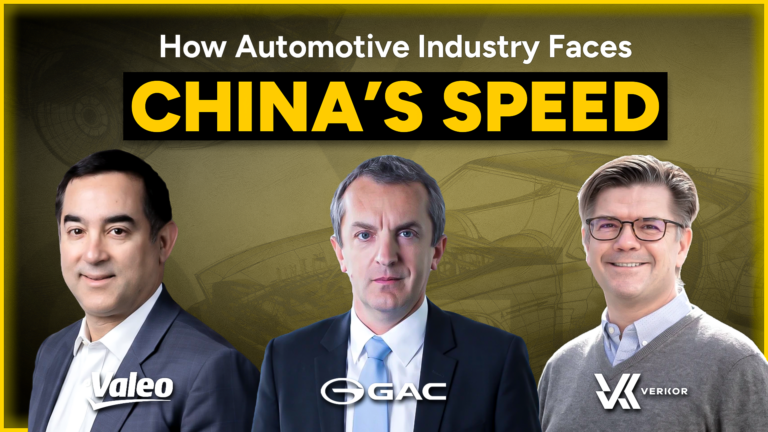

Derek de Bono (Valeo), Gaël de Beauchesne (GAC) and Philippe Chain (Verkor) under the headline "How Automotive Industry Faces China's Speed", Automotive Storytelling episode card
about podcast icon
Under The Hood: Automotive Storytelling
November 24, 2026

Chinese Automaker Speed: What It Means for Suppliers

Chinese Automaker Speed: What It Means for Suppliers - S2E23

Behind every automotive innovation lies a human story. Hosted by Stéphane Lagresle, founder of The Storytelling Tribe, this podcast reveals how industry leaders translate complex technologies into compelling narratives. Through conversations with automotive executives, discover practical frameworks for making automotive innovations relatable and meaningful. For executives, product leaders, and marketers transforming mobility through better communication.


Follow
us on

Share
Episode

Five Whys vs. a Five-Year Plan: How China Moves Faster

Speed, more than technology, is the gap Europe now has to close against Chinese automakers. In this episode of Automotive Storytelling, Stéphane Lagresle looks at Chinese automaker speed through three very different lenses: a marketing leader who has worked inside Japanese, Korean and now Chinese brands, a co-founder building batteries in France, and a Tier 1 executive integrating AI driving software for a Japanese OEM. The three conversations were recorded in Paris in October, and together they draw one picture of where European suppliers stand. For European suppliers, the question now is how fast they can decide.

Key
Insights

  • Speed Is What Europe Is Up Against

    Gaël de Beauchesne has worked inside three Asian industrial cultures: 17 years at Toyota and Lexus, nine at Kia, and now GAC. Toyota plans carefully and asks the five whys before deciding. Kia sets a target and changes route as often as it needs to. Chinese brands decide, commit the means and execute faster than both. Derek de Bono sees the same pace in the market, with China ahead on electrification and moving quickly on driver assistance. For European players, speed has become a competitive variable in its own right.

  • Nobody Builds the Car Alone Anymore

    The three conversations converge on one point. Gaël de Beauchesne explains that GAC chose to work with established Tier 1s such as ZF, Bosch and Michelin, because European quality expectations leave little room for experiments. Derek de Bono describes Valeo integrating Wayve’s AI driving software into its own ADAS domain controller for Nissan’s next-generation ProPILOT. Philippe Chain’s first Verkor cell was designed to Renault’s specification for the Alpine A390. The supplier role is changing shape, and it is growing.

  • Europe Has the Technology but Not Yet the Industry

    Philippe Chain argues that European battery technology can compare with what Asia produces, pointing to Verkor’s NMC pouch cell and its high energy density and fast charging. The gap he describes is industrial. Metals, minerals, active materials and recycling still largely come from outside Europe, mostly from Asia. Localizing that chain is the work of the coming years, with projects such as the Neomat cathode active material plant under construction in Dunkirk. Derek de Bono reaches a similar verdict on the wider market: Europe has catching up to do.

  • AI Makes the SDV Architecture Unavoidable

    Derek de Bono frames the AI-defined vehicle as the next step of the software-defined vehicle. Traditional code was updated only when an update was worth the effort. AI driving systems behave differently: the car runs a distilled version of a larger model that its provider keeps training on new edge cases. Every improvement means a new distilled model sent to the vehicle. Without an SDV architecture, that loop cannot run, which is why he calls SDV unavoidable.

Key Learning Icon

Key
Takeaways

  • Benchmark your decision cycle against Chinese competitors Gaël de Beauchesne’s comparison of Toyota, Kia and Chinese brands shows that the pace of decision is now part of the product. A supplier measuring itself only against European peers may be measuring against the wrong clock, and an OEM moving this fast will expect partners who can follow.
  • Treat Chinese OEMs entering Europe as customers too GAC relies on established Tier 1s to reach the quality level European buyers expect. Brands that choose this route need suppliers who already know European standards, homologation and customers. That is an opening for suppliers who can show it, rather than only a competitive threat to defend against.
  • Plan for a European value chain that is still being built Battery cells are now produced in France, but Philippe Chain is clear that metals, minerals, active materials and recycling are being localized step by step. Sourcing, risk and sustainability plans should assume a chain in transition for several years, with new local options arriving gradually.
  • Design for the model update from day one Derek de Bono’s point is that AI driving features improve through distilled models pushed to the vehicle again and again. Hardware, middleware and validation processes that assume an occasional update will slow that loop down. The architecture has to expect constant change.
Practical Takeaways Icon
Podcast CTA Left Image
pci right

Where Technology Meets Narrative

Under the Hood: Automotive Storytelling uncovers the human narratives driving innovation in an industry that impacts lives worldwide. Hosted by Stéphane Lagresle, this podcast explores how the power of storytelling ultimately connects technology to humans.