
Behind every automotive innovation lies a human story. Hosted by Stéphane Lagresle, founder of The Storytelling Tribe, this podcast reveals how industry leaders translate complex technologies into compelling narratives. Through conversations with automotive executives, discover practical frameworks for making automotive innovations relatable and meaningful. For executives, product leaders, and marketers transforming mobility through better communication.

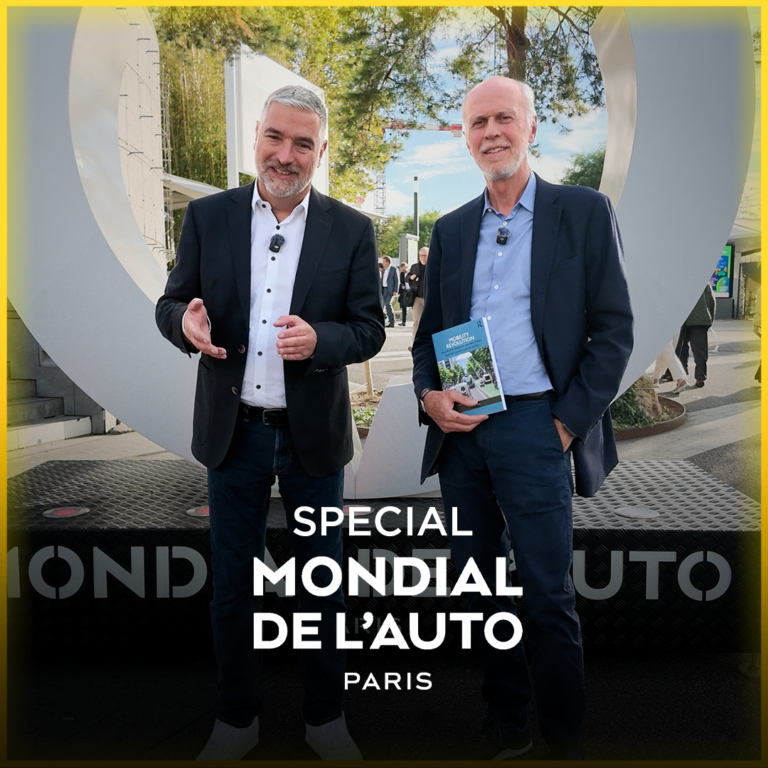
Two years ago, Chinese carmakers had their own hall at the Paris Motor Show. This year they were everywhere. In this episode of Automotive Storytelling, Stéphane Lagresle walks the Paris Motor Show 2026 with Marc Amblard, Founder and Managing Director of Orsay Consulting, to read what the stands reveal about the car industry in Europe.
Two years ago, Chinese carmakers shared a dedicated hall at the Paris Motor Show. In 2026, Marc Amblard counts about 20 Chinese brands spread across every hall, beside Mercedes, Volvo, Renault and Kia. Groups like Chery arrive with several brands at once and watch which one sticks. Marc expects that number to shrink, and sees local production, from XPeng models assembled by Magna Steyr in Austria to BYD in Hungary, as what will separate the brands that stay from those that fade.
Renault’s new R5 and Citroën’s 2CV revival trade on memories that today’s new-car buyers, typically in their mid-fifties according to Marc Amblard, carry from childhood. Nostalgia paired with affordable pricing gives European brands room to catch up on technology. Stellantis adds a second lever: its stake in Leapmotor and majority control of Leapmotor International bring Chinese cost levels and ready products inside the group. Marc calls it keeping your enemies closer, and stresses that the balance with Stellantis’ own brands has to be managed carefully.
The EU’s extra duties on Chinese imports, which Marc Amblard puts at up to about 45%, apply to battery electric vehicles only. Hybrids and plug-in hybrids pay the standard 10%. Chinese groups have adapted their mix accordingly: 98% of the Jaecoo 5s sold in France are hybrids. Marc expects Europe to extend duties to these vehicles eventually, and sees range extenders, already common in China, as a temporary bridge while battery costs come down.
Tesla’s Cybercab has no steering wheel and no pedals, which makes it a Level 4 vehicle and puts liability on the company operating it. Level 2 systems, including the FSD Supervised that Tesla wants to bring to Europe, leave liability with the driver. Marc Amblard, who rode in Waymo, Cruise and Zoox robotaxis during his years in Silicon Valley, explains how Waymo’s remote operators choose between options the car proposes instead of driving it, and why camera-only systems struggle in fog and glare.
Marc Amblard is Founder and Managing Director of Orsay Consulting, advising OEMs, Tier 1 suppliers and startups on electrification, autonomous driving, AI and new mobility. After nearly ten years in Silicon Valley, he is now based in France. His career spans Renault-Nissan, Valeo, PSA and Alstom, and he is the author of Mobility Revolution (2026).
Under the Hood: Automotive Storytelling uncovers the human narratives driving innovation in an industry that impacts lives worldwide. Hosted by Stéphane Lagresle, this podcast explores how the power of storytelling ultimately connects technology to humans.