
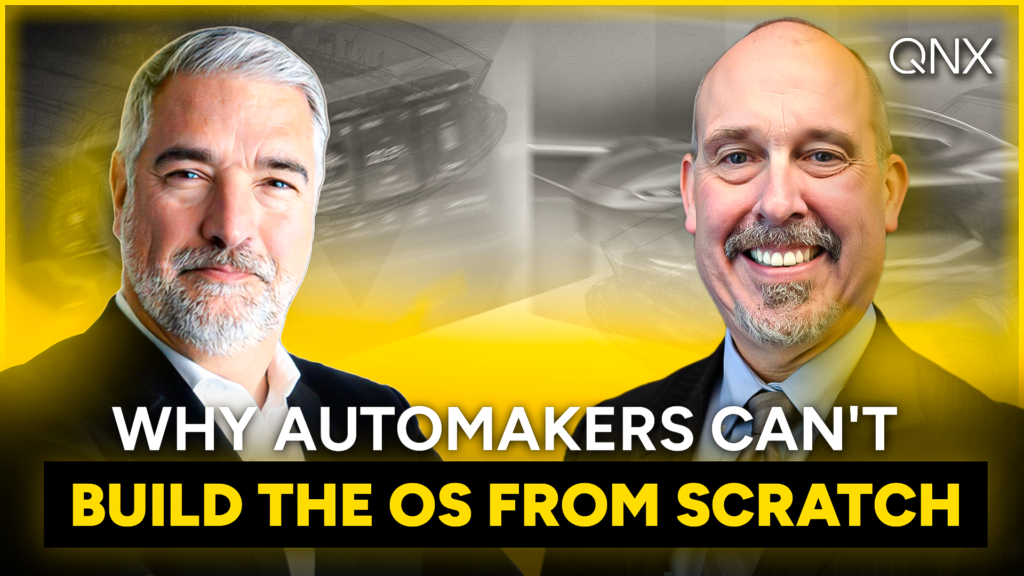
QNX software runs in approximately 275 million vehicles worldwide — including BMW’s Neue Klasse ADAS system. Under President John Wall, who joined the company in 1993, QNX is positioning itself as the platform of choice for physical AI, bringing to robotics and industrial automation the same determinism, safety certification, and security that three decades of automotive programs required.
Key Takeaways
- QNX is embedded in roughly 275 million vehicles across virtually every major OEM, yet most drivers have never heard of it.
- QNX Everywhere, launched in 2023, makes the OS free for non-commercial and R&D use, with over 100 university partnerships already in India.
- Alloy Kore — co-developed with Vector — is the first QNX-rooted product that doesn’t carry the QNX name, a deliberate signal of genuine industry co-ownership.
- QNX describes its model as “commercial open source”: free to develop, supported by a company when you go to production.
- Physical AI’s four core requirements (determinism, safety, security, scalability) map directly onto what QNX has been building in automotive since the early 1990s.
What is QNX, and why don’t most drivers know it exists?
John Wall has a metaphor he uses constantly, and he’s the first to admit people hate it. “We’re the plumbers and the electricians,” he says. “We’re the guys and girls with the lunchbox and the hard hat that build stuff, so that other people can build beautiful things on top of it.”
QNX is a real-time, safety-certified operating system that sits beneath the dashboards, ADAS systems, and gateways of roughly 275 million vehicles on the road today. It powers BMW’s Neue Klasse ADAS architecture. Mercedes-Benz, a long-standing QNX customer, was the first OEM to achieve series-production Level 3 approval — and Wall is open about the pride QNX takes in what its customers accomplish. QNX has been white-label by design: mission-critical software that works invisibly, certified to functional safety standards, and intentionally kept out of the consumer spotlight.
That is starting to change. Wall, who became President in November 2025 after more than three decades at the company, is now running a deliberate awareness campaign. Part of the motivation is competitive. “A lot of people have shared with me, well, automotive is a slow industry, it’s not very innovative on the software side,” he says. “I actually believe that automotive is the most complex consumer device that there is. And automotive is actually the tip of the spear.”
His argument: everything the automotive industry learned about multi-core safety, security, connectivity, and autonomy is now arriving in robotics, industrial automation, and higher-performance compute. QNX wants to be known before those markets mature.
What is QNX Everywhere, and why is making an OS free actually a strategic move?
After COVID, Wall traveled to meet customers across the globe. The feedback was consistent: “We like using your product. But we can’t get anybody out of school that knows anything about QNX.” Engineers trained on Linux arrived at automotive programs and found a capable but unfamiliar environment. They didn’t have the tools they expected. They felt constrained.
QNX Everywhere launched at the ACC show in Detroit in 2023. The program makes QNX available for free for non-commercial use — students, hobbyists, and R&D teams running proofs of concept. Wall says the download has to be one click. “People were talking about, well, you got to sign up and do this,” he recalls. “I said, no. One click.”
The ecosystem ambition goes further than accessibility. QNX is a POSIX-compliant operating system, which means most open-source projects that run on Linux can be ported to QNX. Under QNX Everywhere, the company is systematically porting the most popular open-source libraries — libcurl, AI frameworks, development tools — optimizing them and pushing them back to the community with proper support, rather than doing one-off internal ports that disappear into a release.
The university push in India has already reached over 100 institutions. Wall frames the goal plainly: “We really want to elevate QNX to a level where it’s at an equal playing field with Linux from an accessibility perspective and from an ecosystem perspective. We’re not kidding ourselves. This is not going to happen in a year.”
The commercial logic is straightforward. R&D teams previously couldn’t afford development seats. Now they can build on QNX from day one. When a program goes to production, those teams already know the platform.
How does QNX describe its relationship with open source?
The phrase Wall’s team landed on is “commercial open source.” It sounds like a contradiction, but he says it resonates because it captures something real: “Open source is free like a free puppy. You get a puppy for free, but there’s all the maintenance, the veterinarian bills. And I don’t think there’s anybody in automotive that will tell you it’s truly free.”
QNX will open more of its source code over time. The kernel stays closed — Wall describes it as “our secret sauce” — but the surrounding tooling and platform components are increasingly transparent. The SCORE initiative in Europe, driven by BMW, illustrates the approach: QNX provided SDP8 and its full tooling for free to underpin SCORE’s open-source automotive development work. [SCORE initiative, BMW Group]
The POSIX compatibility argument is central here. Developers moving from Linux to QNX don’t need to rebuild their mental model from scratch. Pthreads work. The toolchain is familiar. The architecture differs — drivers run outside the kernel in QNX, which makes debugging more tractable in many cases — but the surface-level experience is designed to feel adjacent, not alien.
What is Alloy Kore, and what does it signal about automotive supply chains?
In 2018, Wall’s team designed a platform concept they called Project Green. The idea: build a shared ADAS foundation on two or three likely hardware platforms and let OEMs differentiate on algorithms, not infrastructure. They brought it to OEM customers. The response was polite rejection. Most OEMs still believed they could build the full stack from the ground up.
Then something shifted. Wall started noticing that Vector was showing up in almost every major ADAS program alongside QNX. Integration challenges between Vector’s adaptive AUTOSAR stack and the QNX foundation kept surfacing at customer sites. The two companies started working together to find those problems in the lab rather than in production.
In 2023, an OEM came to Ottawa and asked: “Could you do more?” Wall pulled up the 2018 Project Green slides. “They said, yes, we want that.”
The result is Alloy Core — a jointly developed, safety-certified platform foundation that QNX and Vector co-own. It’s the first product in QNX’s history that doesn’t carry the QNX name, which Wall acknowledges is deliberate. “We’re just the first two founders,” he says. “This is something we expect to grow. We expect to bring other players into it.” The architecture allows distributions to be built on top — for digital cockpit, for ADAS — while the foundation stays shared. [Alloy Kore, QNX]
The underlying argument is one Wall has been making for three years: “Imagine if iOS was being rewritten every year. The reason handset companies can continue to innovate is that applications don’t need to change — they just need to grow. We need something like that in automotive.” OEMs that keep rebuilding the foundation from scratch can’t compound on what they’ve already built. Alloy Core is the bet that enough of the industry now agrees.
Why is QNX positioning itself as the platform for physical AI?
Wall is direct about the pressure he’s faced. “I have been pressured to come up with an AI story for QNX for many years.” His answer took time to develop because he refused to force one that didn’t hold technically.
The story he landed on starts with a question he tells people to search themselves: ask ChatGPT or Gemini what properties physical AI requires. The answers come back the same way: determinism, safety, security, scalability. “These are things we’ve been talking about at QNX for the longest time,” Wall says. “We have not been talking about the deterministic aspect because it hasn’t been in focus. It’s now becoming critical.”
In robotics and industrial automation, jitter — unpredictable variation in when a computation completes — is a genuine engineering problem, not an edge case. PLCs running factory automation need to know that an instruction executes within a bounded time window, not approximately. Wall says QNX has been benchmarked against Linux and other real-time operating systems by industrial customers, and the results have been favorable for the use cases where determinism is non-negotiable.
QNX is porting every major AI framework to the platform — CUDA, TensorFlow, Snappy — and making them available to the community through QNX Everywhere. What they will not do is allow AI to generate safety-certified code without a human in the loop. “I can’t have AI vibe-coding QNX products,” Wall says. AI is used internally for tasks like unit test generation, but the core product remains human-verified. For safety-certified software, that line isn’t arbitrary. [QNX functional safety approach]
The market entry is already underway. Several large industrial automation companies have run comparative benchmarks across operating systems and selected QNX for high-performance compute use cases. Wall frames it as a natural expansion rather than a pivot: automotive was always the proving ground. Robotics is the graduation.
What does John Wall actually think about autonomous vehicles?
He’s been cynical for a long time, and he says so plainly. “L4, L5 is very difficult, especially in areas with weather. A lot of this is going on in California. It’s not going on in Ottawa or Toronto or Montreal.”
His view on the path for consumer vehicles: Level 2 and Level 2+ are where real-world adoption happens. Level 3 came with speed restrictions and sensor costs that made the value proposition questionable for most drivers. OEMs pulling back from L3 toward L2+ is, in his reading, a rational recalibration rather than a failure.
Waymo and the robotaxi operators are a separate category, with a fundamentally different business model. They’re not trying to sell a car — they’re trying to build a service. Wall thinks they still have years of work ahead before that service is trusted ubiquitously across different geographies and weather conditions.
Where he sees the genuine SDV unlock is OTA — over-the-air updates — and the ability to monetize software after the vehicle is sold. “Once OTA is really established and you start to see the SDV evolve, the OEMs can start to recognize value add and monetize it. Add new features that people want and are willing to pay for.” The dream most OEMs have articulated for SDV is a recurring revenue model built on high-margin software. OTA is the infrastructure that makes it possible.
Wall’s personal benchmark for how far the industry still has to travel: “I bought a 2016 version of a car and recognized the software was what I worked on in 2008 and launched. Eight years later, it was the same software.” That gap — between what the industry said it would deliver and what it actually shipped — is what Alloy Kore, QNX Everywhere, and the physical AI positioning are all trying to close.
FAQ
Does QNX run in my car?
It very likely does. QNX software is embedded in approximately 275 million vehicles globally, across most major OEMs. It typically runs safety-critical systems including ADAS, digital instrument clusters, and vehicle gateways — components that don’t carry the QNX brand name in any consumer-visible way.
What is QNX Everywhere?
QNX Everywhere is a program launched in 2023 that makes QNX available for free for non-commercial use — students, hobbyists, and R&D teams. It includes free licenses, build server access, and a growing library of open-source software ported and optimized for QNX. Commercial production use still requires a paid license. [QNX Everywhere program page]
Is QNX open source?
QNX describes itself as “commercial open source.” The kernel remains proprietary. An increasing amount of surrounding tooling and platform code is being opened, and QNX actively supports open-source projects being ported to its platform. The distinction matters in production: open-source Linux has no warranty or liability coverage; QNX provides both.
What is physical AI, and why does it need a specialized OS?
Physical AI refers to AI systems that act in the real world — robots, autonomous vehicles, automated manufacturing equipment — rather than purely in software. These systems require deterministic timing (knowing exactly when a computation will complete), safety certification, security, and scalability across multi-core hardware. Standard general-purpose operating systems don’t guarantee those properties by design.
What is Alloy Kore?
Alloy Kore is a jointly developed safety-certified platform foundation built by QNX and Vector. It’s designed to provide a stable, shared base layer for automotive ADAS and software-defined vehicle programs, so that OEMs can focus engineering resources on features rather than on rebuilding foundational infrastructure in every program. It’s the first product in QNX’s history that doesn’t carry the QNX brand name.
Can AI be used to write safety-certified automotive software?
Not fully autonomously, based on current practice at QNX. John Wall is explicit that AI tools like code generation cannot be applied to safety-certified software without a human in the loop. QNX uses AI internally for tasks like unit test generation, but the core product requires human verification. For software where a failure can injure someone, the certification chain requires traceability that autonomous AI generation cannot yet provide.
This episode of Under the Hood: Automotive Storytelling was hosted by Stéphane Lagresle and produced by The Storytelling Tribe. John Wall is President of QNX, the real-time operating system division of BlackBerry. He joined the company in 1993 and has held roles across engineering, operations, and general management.
Listen to the full episode on Under the Hood and follow the show wherever you get your podcasts.
Sources:
BMW and QNX announcement during CES 2026
Alloy Kore
QNX Everywhere